Retro Tech
The TurboGrafx-16 and PC Engine: NEC's Brilliant Middle Child
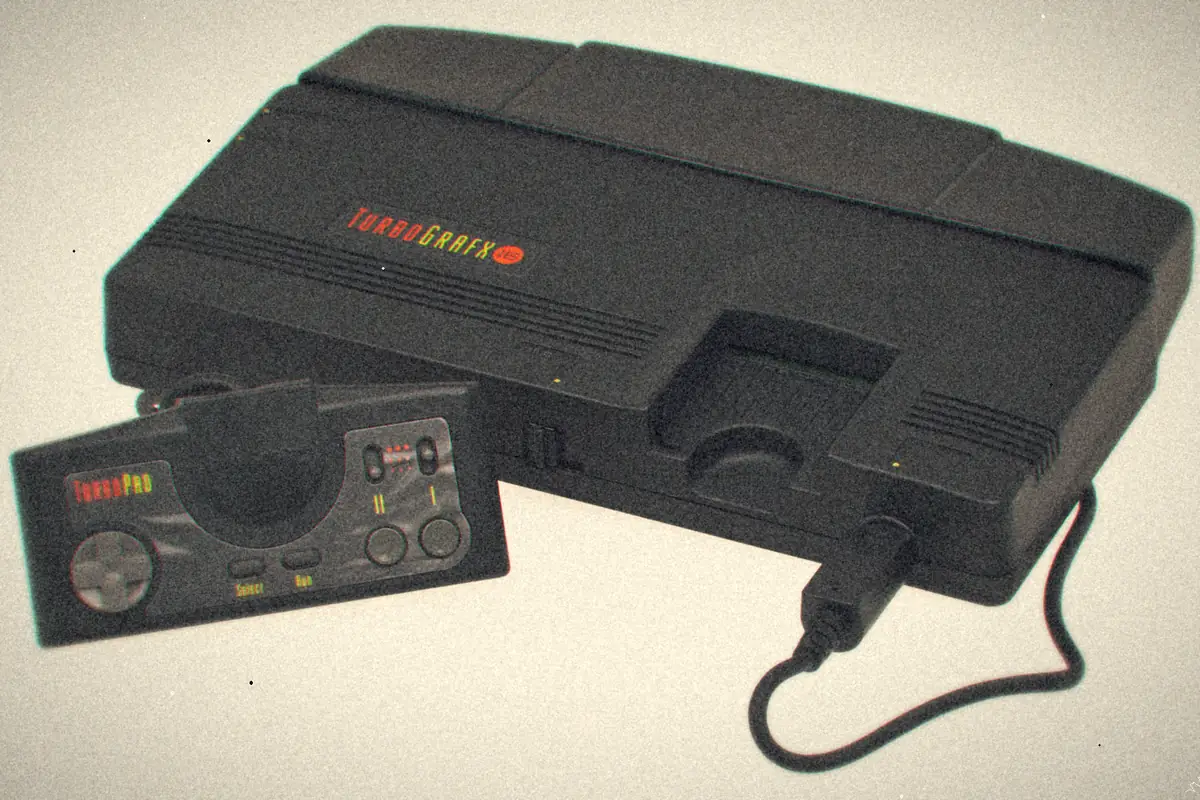
Part 2 of the thread Console field guide
- Made by NEC and Hudson Soft. Launched in Japan in 1987 as the tiny PC Engine, in North America in 1989 as the bigger TurboGrafx-16.
- An 8-bit CPU with graphics that could hold their own against 16-bit consoles, which made it hard to market.
- Its CD-ROM add-on arrived in Japan in 1988, years before CD gaming went mainstream.
- Japan got several hundred more games than America did. A lot of the best ones never came over.
The TurboGrafx-16 sits in a strange spot in console history. It arrived between the NES and the Super Nintendo, it was technically impressive, it had some wonderful games, and in America almost nobody bought one. In Japan, under its original name, the PC Engine, it was a big hit.
It's one of the great "what if" machines, so this is a field guide to it: where it came from, what made it odd, what to play, and how to play it now.
Two names, two very different launches
Hudson Soft had been making games for Nintendo's Famicom and wanted to get into hardware. It teamed up with NEC, and the PC Engine came out in Japan on October 30, 1987.
It was tiny, barely bigger than a stack of a few CD cases, in white with red accents. Games came on HuCards, thin credit-card-sized cards, and it could do things on screen the Famicom couldn't. Japan loved it.
For North America, NEC made choices that didn't help:
- A bigger, black redesign that lost the charm of the original.
- A new name, TurboGrafx-16, to lean on the "16-bit" idea.
- A launch on August 29, 1989, after Sega's Genesis was already out.
- Limited early distribution, starting with New York and Los Angeles.
- Marketing that never really explained why you'd want one.
Put that up against Nintendo and Sega at full strength, and it ended up with a small slice of the American market.
The 8-bit, 16-bit problem
The hardware was an odd mix:
| Part | What it had |
|---|---|
| CPU | Hudson's HuC6280, an 8-bit chip running at up to 7.16 MHz |
| Graphics | A 16-bit video chip set: 482 colors on screen from a palette of 512 |
| Sprites | 64 on screen, 16 on a single line |
| Sound | Six channels of wavetable sound, in stereo |
| Media | HuCards (called TurboChips in America), and CD-ROM with the add-on |
That mix was a marketing headache. Sega sold the Genesis as a "true" 16-bit machine, and the TurboGrafx's 8-bit CPU was an easy target, even though its graphics could match or beat the Genesis in some ways.
The first CD add-on
This is the part that aged best. NEC released the CD-ROM² add-on in Japan in December 1988, and the TurboGrafx-CD followed in North America in late 1989. That was years before CDs became the normal way to ship console games.
CD meant much bigger games, real CD audio instead of chip music, animated cutscenes and voice acting. The Super CD-ROM² and then the Arcade Card added more memory later, for more ambitious games and closer arcade ports.
The games
On HuCard:
| Game | What it is |
|---|---|
| Bonk's Adventure | The unofficial mascot, a caveman who headbutts everything |
| Blazing Lazers | A fast vertical shooter |
| Devil's Crush | Pinball with a demonic theme, and a strong candidate for best video pinball ever |
| Military Madness | Turn-based strategy |
| Neutopia | An adventure that owes a lot to Zelda |
| Dragon's Curse | A port of Wonder Boy III: The Dragon's Trap |
| Bomberman '93 | Multiplayer Bomberman at its best, with a TurboTap |
| Air Zonk | A goofy, fast shooter from the Bonk universe |
| R-Type and Splatterhouse | Arcade ports |
On CD:
| Game | What it is |
|---|---|
| Ys Book I & II | An early showcase for CD audio and voice acting in an RPG |
| Gate of Thunder and Lords of Thunder | Shooters with loud, wonderful rock soundtracks |
| Castlevania: Rondo of Blood | A Japan-only release, and a lot of people's favorite Castlevania |
| Snatcher | Hideo Kojima's cyberpunk adventure, Japan-only on this system |
| Cosmic Fantasy 2 | A story-heavy RPG with anime cutscenes |
The libraries were very different sizes. Japan got several hundred games across HuCard and CD. North America got somewhere around 130 to 140. Plenty of the best Japanese games, and much of its anime-flavored catalog, never came over.
Tip
If you're buying real hardware, a region-free mod or a HuCard adapter opens up the much bigger Japanese library. The HuCard pins are wired differently between regions, so the cards don't just swap across.
Every version of the hardware
NEC made a lot of variations, which says something about its commitment and also confused people:
- PC Engine: the original white Japanese console.
- CoreGrafx: a redesign with AV output.
- Shuttle: a budget model.
- SuperGrafx: an upgraded model with more graphics power, and only a handful of games that used it.
- PC Engine GT / TurboExpress: a handheld that played the same HuCards as the console.
- PC Engine LT: a portable with a built-in screen.
- Duo: the console and CD drive in one box, sold in America as the TurboDuo.
Add the CD drives, the Arcade Card, the TurboBooster for better video out of the American console, and the TurboTap five-player adapter (the base system only had one controller port), and you can see why buyers got lost.
Why it didn't catch on in America
- It launched after the Genesis.
- The marketing didn't land.
- Distribution was thin at first.
- One controller port out of the box.
- Third-party support was weak, partly thanks to Nintendo's licensing terms with publishers.
- The best games stayed in Japan.
Playing it now
- The TurboGrafx-16 Mini came out in 2020 with a built-in library of Japanese and American games.
- Nintendo Switch Online has had PC Engine and TurboGrafx games, and the Wii and Wii U Virtual Console had plenty before that.
- Emulation: Mednafen is excellent, RetroArch has good cores for it, and the MiSTer FPGAA chip that can be configured to behave like other hardware. Retro consoles like the MiSTer use one to recreate old systems at the circuit level instead of emulating them in software.More: Preserving Your Own Game Collection: Dumps, Backups, Boxes and Old Hardware recreates the hardware. MagicEngine is the long-standing Windows option.
- Original hardware: it's collectible and not cheap anymore. RGB modA modification that gets a console's clean red, green and blue video signal out to the TV, instead of the blurry composite picture most of us grew up with.More: RGB and Retro Consoles: Which Ones Need a Mod and Which Just Need a Cable, HDMI adapters and optical drive emulators for the aging CD units all exist.
It's a small library to start, which makes it a nice system to get to know. TurboGrafx and PC Engine CD are both in my own backup collection, filed with genre-code names, and if you have the hardware and want the best picture out of it, RGB modding covers the options. It shared a generation with the Genesis and its three models.